New Publication on Gerhard Mercator
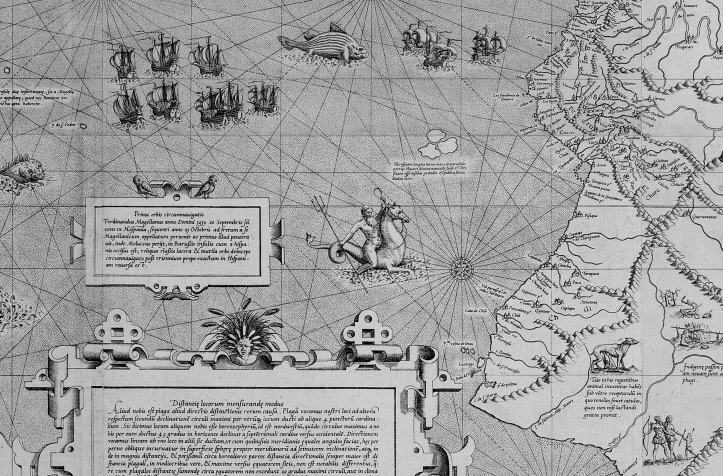
This newly published volume examines the scholar and his work within the context of medieval and early modern discourses. An essay by Martina Stercken sheds light on Mercator’s 1569 world map from a perspective that has been little explored in the history of cartography to date. After Jerry Brotton had already reflected a few years ago on the possible theological significance of the loxodromes on Mercator’s world map, the Zurich professor now analyzes this cartographic milestone from a general semiotic perspective. The examination of the visual language and the structure of the graphic composition reveals individual traces in the world map ad usum navigantium (setting aside for the moment the well-documented technical innovation that the map undoubtedly represents) still points to the tradition of encyclopedic world maps, which, since the 13th century, have also marked the locations of historical and mythological sites. The 1569 world map thus stands as a semiotic example of the gradual transition between the cosmographic worldviews of the Middle Ages and a mathematical cartography of the modern era that has emancipated itself from historiography.
Ute Schneider and Stefan Brakensiek (eds.): Gerhard Mercator: Science and Knowledge Transfer. Darmstadt: WBG, 2015. 375 pages : illustrations, 978-3-534-26451-3