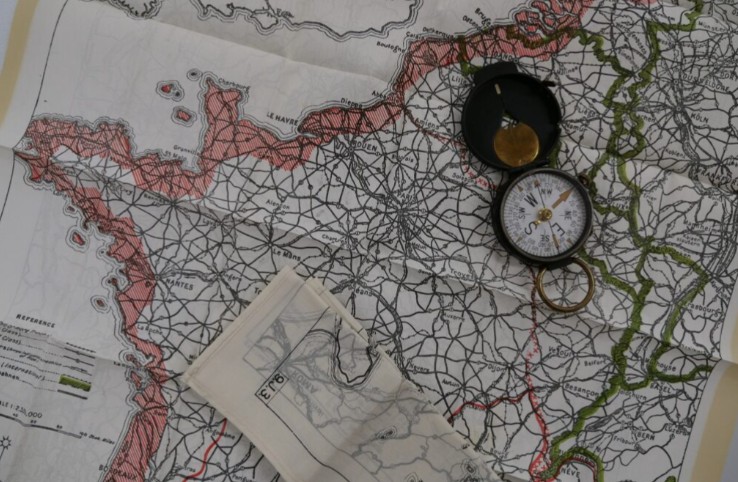
Handkerchiefs as Escape Aids During World War II
In December 1939, shortly after the outbreak of World War II, a new department was established in London: MI9. MI9’s main task was to help Allied soldiers who had been shot down or captured behind enemy lines to escape. The most important tool for such an escape was a map—a so-called “escape map.”
Some escape maps were sewn directly into uniforms, while others were used as disguised “handkerchiefs.” This method allowed soldiers and pilots to access their maps discreetly. After all, a person with a supposed “cold” can move about more inconspicuously in enemy territory than someone holding a large military map right in front of their face.
For soldiers who were captured without these maps, or whose escape maps were confiscated after their capture, these escape aids had to be smuggled directly into the German prisoner-of-war camps. Here, the escape aid workers demonstrated great ingenuity: Monopoly games, sewing kits, and spools of cotton thread served as camouflage. Hidden inside them, however, were not only the escape maps but also compasses, real money, and other essential survival items.
The Maps and Panoramas Department houses an extensive collection of diverse escape maps—ranging from Northern Europe to North Africa.
The escape maps of the Zurich Central Library in the catalog